I forgot about tax season . . .

When I restarted at WordPress, I had the best intentions in the world to post over 111 days.

I forgot about tax season.

I’m a tax lawyer.  How could I forget about tax season?

Ah well, picking up the threads now.  I’ve actually been writing posts — just haven’t been able to get here to post them.

So there will be a steady stream of posts the next few weeks while I catch up.

Thanks for your patience!


We waste water

We waste water here in the United States . . . and no, I’m not talking about swimming pools.

I recently read several books about the water wars of the past 200 years in the United States.  I knew about the California wars, courtesy in part of the movie ‘Chinatown’, but who knew there were wars over water along the Great Lakes and in the Dakotas, high up in the mountains and quite literally throughout the entire country?  Once I’d read those books, I started thinking about all the ways I use water.

Our country has been experiencing a rather widespread bout of drought for at least the last two years.  The south, southwest, midwest and western mountains, even areas on the Pacific Coast, were bone-dry last summer.  Farmers’ crops withered in the fields.  Cattlemen were forced to sell their herds because they could no longer afford to buy feed or ran out of water to keep them alive.  One town even had to literally truck in water, because their sources completely dried up.

And that was just in the United States.  Over the last several years, I remember hearing stories about widespread droughts in Europe, Africa, Asia.  Polluted drinking water sickening entire villages.  The desserts expanding ever-rapidly, driving people from their homes into makeshift refugee camps.

People everywhere without adequate water to drink.

I have a bad habit of letting the water run while I brush my teeth.

Seriously, I never thought about it.  Flip on the faucet, wet the toothbrush, add toothpaste and brush, then rinse out your mouth and rinse off the toothbrush.  How much water could I possible be using?

A lot. Well over three gallons.

I stuck a basin into the sink and did my usual brushing Sunday night.

The basin overflowed.  It normally holds three gallons — and it overflowed before I had even finished brushing my teeth.

To put this in perspective, I’m told my dishwasher only uses five-six gallons of water on a normal wash cycle.  That’s six gallons to wash twice as many dishes as I have teeth, plus pots and a large amount of utensils.  And I usually run the dishwasher every three days or so — which means I am wasting three times more water brushing my teeth than I need to run the dishwasher once.

Those wasted gallons of water could have allowed a rancher to hold onto a cow.  Ensured the farmer could provide me with cobs of corn for a July 4th barbecue.  Let someone take a shower instead of a sponge bath.

Kept someone alive for a few more days in another country.

And then I started noticing other ways I’m not water-conscious.  I let the water run while I’m conditioning my hair and shaving my legs in the shower.  I fill up a pot with water to cook — and put the pot on the stove before I turn off the sink’s faucet.  I drink half a glass of cold water and when it gets warm – I dump it out, then get a new glass of cold water.

There are more, but listing my sins isn’t really the point.  The point is — all those little, unneeded, overuses of water add up, very quickly.  I estimated that I waste probably twenty-thirty gallons or more just between the shower and brushing my teeth.  It doesn’t sound like a lot of water, until you realize what you could do with it besides letting it run into the sewers.

Water crops.  Keep people and animals alive.

Put a little less strain on critical supplies at a time when water is an ever-more-scarce resource.

I’m not talking about banning pools, or saying never wash your car or water your lawn.  I’m talking about the little ways we just use water without purpose.  If we all just thought, turned off the faucet once or twice instead of letting the water run, how much water could we save?  There’s 300 million people in this country — how many of us are letting gallons of water run down the drain, unused?

Eventually, hopefully, our drought here in the United States will end.  But the fact remains, water is a finite source.  We can survive with different food sources — substitute chicken when beef is unavailable, enjoy brussel spouts when asparagus prices go up.

We can’t live without water.

And we’re wasting it.

The groundhogs are frisky . . .

Spring is definitely on the way — the groundhogs are frisky.

My company is located in a small office park on the site of a former farm.  Each building is surrounded by wooded areas with a stream running between and behind the offices.  Just around our building, we’ve found hazelnut, sassafras, crabapple, chokecherry, oak, hickory, elm and thorn trees, as well as honeysuckle, wild rose and various berry bushes.  The thickets and stream make an ideal mini-habitat for wildlife, and despite the surrounding highways, we enjoy watching the deer, foxes and rabbits, plus the occasional skunk, wander by the windows.  At last check, our bird count was over 60 varieties, including red-tail and Cooper’s hawks and a sharpshin hawk we think is nesting somewhere near the stream.

The only wildlife we could do without are the non-migrating Canadian geese.  They literally run across the roofs of the buildings — the noise is horrendous, and we won’t discuss the mess they leave all over the lawns.  On the other hand, the foxes love them.  Despite the size difference, I’ve twice seen a red fox hauling a goose across the lawn, taking it home for dinner.

However, our personal favorites are the groundhogs — each building has a least one groundhog as a tenant.

Our building has had two for the last three years — Freddie on the front lawn, Phoebe in the woods to the side of the building.  Each year, as summer blends into autumn, we watch the ‘hogs getting fatter, and fatter — and slower and slower.  By October, they’re keeping close to their dens, ready to run and hide at the first sign of danger.  (And danger there is from the hawks overhead to the foxes roaming the lawns.)

But in spring — ah, spring brings groundhog love.  They’re svelte, active, happy groundhogs looking to start a family.  We can always tell when it’s spring — first we sight the groundhogs out of their dens, each grazing their ways through the clover on their respective lawns.

Then, we’ll see Freddie amble over to join Phoebe on the side lawn.

A month or so later, Freddie will move back to his prime real estate on the massive front lawn, with its deluxe, multi-entrance burrow against the warm wall of our building.

And Phoebe will show up being trailed by a couple of miniaturized groundhog babies.

This is how I can tell spring is definitely here.  Friday I spotted Freddie and Phoebe on their individual grazing grounds.

Sunday Freddie was dining with Ms. Phoebe.

Romance is in the air — and so is spring.

(originally to be posted on Saturday, but work interfered)

A Perfect Match

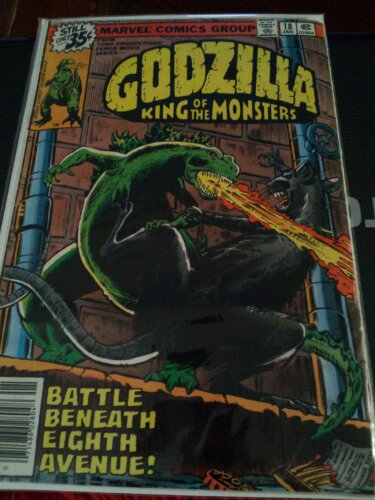
Godzilla + Marvel comics = Perfection. Two of my favorite things in one place. How did I miss this one?

image

Yes, you are seeing Godzilla fighting a rat.

No, the rat isn’t a giant prehistoric rat mutated by radiation.

Godzilla has been shrumk.

By Marvel comics’ Pym particles.

Perfect!

I adore Godzilla — I once passed an entire winter weekend, snowed in, watching every film in order. And as you probably already know, I love Marvel comics as well. But somehow, I managed to miss the fact that Marvel had published 24 issues of Godzilla, King of the Monsters. Until, that is, the wonderful people at Showcase Comics, knowing my love for the Great Giant Lizard of Doom, mentioned that there was this comic with Godzilla fighting a rat. A teeny, tiny Godzilla. I bought it — and wow.  There’s S.H.I.E.L.D.! And Dum-Dum Dugan! And a helicarrier of sorts dedicated to hunting down monsters!

And of course, there’s Godzilla, who’s suffered the indignity of being shrunk, although it’s so he can be safely relocated elsewhere. But that goes awry (of course it does, it’s a comic, when does any operation like this one go smoothly in the comics!?!).  He gets dumped into the river and ends up washed into the sewers of New York City. Once there, he has to face down the foulest monster the city has bred — a rat. Poor ‘Zilla. And poor rat, suffering the delusion that it could defeat Godzilla.

I absolutely have to find the rest of this series. Wikipedia tells me that the series was gathered into a trade paperback, and if I can’t find the individual issues, I’ll have to settle for that book. Still, it’s Godzilla. And Marvel. Together.

Let’s hear it for crossovers!


(and again, meant for Sunday, March 10th, but work!)

Alas, Marvel

Oh Marvel, why did you have to screw up my digital comics addiction?

I love comics.  Oh, I love books, and movies, and TV shows as well.  But comics are different.

The books I like run the gamut from entertaining and funny to self-improving and thought-provoking.  My favorite movies and TV shows are tear-jerking, soul-rending, heart-stopping and sometimes outright terrifying.  But comics?  Comics combine all those emotions with laughter and comfort.  Comics take me back to simpler times, when I could count on my heroes to to solve every problem while quipping one-liners.

I race to comics when I’ve had a particularly nasty day, because where else can I get a quick emotional boost and a thorough distraction in less than 40 pages?  And above all comics, I worship Marvel.  Truly.  But this latest redesign of their website — forget it.  I’ve seen new Microsoft products with fewer bugs and less customer irritation.

Marvel Digital Comics Unlimited was a wonderful feature that fit perfectly into my ‘digitize’ mantra.  Thousands of back issues, neatly formatted for a convenient reader.  I could track what I’d read, mark comics to read in the future, toggle easily from one comic into the next in the series.  If I was eager to read more about Hawkeye I would just search the character.  And if I wanted to revisit the Secret Invasion, I could just search for the series.

I have a subscription to MDCU.  Had.  Have — at least until I call the bank tomorrow and ask about reversing the charge.  You see, Marvel ‘improved’ MDCU, transforming it into the new “Marvel Unlimited.”

Improved it as in removed the features that made it enjoyable and transformed it into something so impossible to use that I’m essentially paying for something with little resemblance to what I thought I was buying.

Rather like paying for a new pair of Manolos and getting the left shoe from a used pair of low-budget sneakers.

I can’t even begin to list the problems I’ve found in trying to use it — that is, when the website isn’t jamming and freezing to the extent I nearly have to physically shut down my computer to get out of it!  No way to record what I’ve read or what I want to read.  No easy way to toggle into the next comic in the series.  The few comics I tried to pull up took so long to load that I gave up and backed out.  When something did load, the new reader did such a poor job of aligning it that I couldn’t read half the print and again backed out.

Useless.  And my resolution for 2013 is to eliminate useless things.

I won’t stop reading comics — but it looks like I’ll be sticking to the print ones now.  And since I’ll be print-only, well, I’ll probably buy fewer Marvel and expand out into other comics.  Been awhile since I read Batman, there’s the new Arrow — time to check out DC and the indies, I think.

Great sigh of sorrow, here.  I really, really wanted their redesign to work.  I loved MDCU.  It was my go-to place.  I had big plans for reading my way through whole series I’d missed.

Guess Netflix will be getting a workout, now.

The freedom to walk away

There is a certain freedom in giving up on something.

On taking one last, long, regretful look at it and saying “You know what? I’ve given it my all. I’ve tried. It’s not going to change, no matter how much more time and effort I put into it.”

And then you take the steps needed to walk away.

My parents drilled into me an exceptionally strong work ethic. No matter how hard or tough or bad or unpleasant something became, no matter how dark and deep that water was getting, you never gave up. You kept trying to improve it, change it into something better, for yourself and everyone else involved in it. You just hunkered down and gave it your all, to invoke the cliche.

But sometimes, your all just isn’t enough. You spend a solid year working on something, you try to solve it, you devote hundreds of extra hours to it – and in the end, there’s nothing more you can do about it.

Because the other parties involved don’t want it to change.

When you hit that wall (hopefully not at an excessive speed), continuing the effort isn’t adhering to a good work ethic, it’s just being plain stupid. You have to accept that the situation isn’t going to change.

And then decide whether to stay – or move on.

In one area of my life, I now accept that I have to walk away. I’ve poured my heart, my energy, my not-inconsiderable intelligence and experience and creativity into it. It’s been a year. I took a hard look at it again today and realized – nothing has changed. Nothing will change. The power to change it is not within my control. The parties who have that control look at the situation and either don’t see the change that’s needed – or see it and, frankly, just don’t care to change it.

It’s the classic case of “You can lead a horse to water, but you can’t make him drink.”

When that happens, you can do one of two things. The solution so many people seem to choose is ‘close your mouth and endure in silence.’ And many situations warrant that approach – because they offer enough benefits in exchange for the inconvenience, annoyance and/or hardship to be endured.

That’s not the case here.  There are benefits, but honestly, I saw today that they don’t outweigh what I’ll have to continue dealing with if I continue on this course.  Having led the horse to the pond, it’s just standing here, looking at me.  I know it’s not going to drink. It may stand there forever, or it may choose to bite me.

It goes against my every instinct, but I have to say – it’s time. Time to change what I can control, which is my interaction, my continued participation, with it.

I realized that around 6 this evening. I expected to feel sad, to feel regret, to feel grief.

I didn’t expect to feel happy.

But I do. I gave it everything, and I can walk away without regret. The relief of having finally made a decision about it, of having accepted that it is futile to keep trying, is incredible.

Now I just have to stick to my resolution and walk as fast as I can.

This is me walking very fast.

Spring-cleaning, green(ish)-style

The approaching snowstorm notwithstanding, spring will arrive in 15 days. It’s time to start that annual optimistic exercise known as spring-cleaning.

Every year, I spend a few days cleaning out my apartment before spring. I vacuum down walls and shampoo carpets. Invest time in waxing and polishing all the furniture. Turn mattresses, wash slipcovers, wax floors. And inevitably, in sorting through a few closets and drawers, I pull out some items which are broken, or no longer needed. And usually, those items get thrown out.

But our landfills are taking over the countryside, filled with discarded items containing toxic substances that could pollute our environment. Charities in the area are always in need of household goods and spare clothing. And there are some things that I’ve bought, or been given, that I never/no longer need, that could be sold and the funds used to better purposes.

And so I have decided to spend the next four weeks in a deeper form of spring-cleaning, “green(ish)” style. I’m going to go through every closet, every drawer, every item in storage. I will be ruthless in my culling — if I haven’t used it, read/watched it or even thought about it for at least a year, it will be up for disposition.

But instead of throwing things out, I’m going to see how many of these items can be recycled, either by sale or donation.

Some things will be easy to handle. Clothing, books, entertainment media — these items can all be either resold at used stores or donated to libraries, charities or shelters. Old computers or televisions can be taken to a recycling facility.

But then what do I do with old furniture? I don’t have a curb to place it on, so that people driving by can take it and give it a better home. I have a plentiful supply of knick knacks, those little gifts that inevitably turn up as presents at birthdays and holidays. Can I list them on Craigslist? Or can they be donated to a charity that can resell them and earn much-needed cash?

My goal is to recycle/donate/sell at least 75% of my discarded items. Stay tuned for updates!

Caretaker of the cemetery

Cemetery caretaker — officially, the oddest job I’ve ever held.

One of my tasks for the rest of this year is to pay a lot more attention to my career. There are a lot of steps involved — looking where I am, deciding where I want to go, assembling resources to get there — but a major step is always to do a have/need analysis. What do I have with which to work, and what do I need to get where I want to go? And a large part of the ‘have’ equation involves the skills developed over time.

Which is a long-winded way of saying I sat down and listed every job I’ve ever had, and what I learned to do while on those jobs. I went all the way back to my days as a six-year-old recess monitor, through my high school and college days as a waitress and catering cook, and into my ‘adult’ work life, where I started as a journalist.

In my current incarnation, I’m in-house chief counsel for a corporation. In my journey through corporate land, I’ve held some intellectually interesting positions — regulatory and compliance officer, tax manager, audit specialist, human resources director. I’m experienced in a variety of legal areas like regulatory, tax, contract and intellectual property. And litigation, of course — if you’re a lawyer you can’t escape litigation in one form or another. I am still responsible for some of these areas as counsel at our company.

But on my list two labels stood out — building services manager and cemetery caretaker.

I was part of a new management team at a previous company, and as the last to join the team, I was designated building services manager. How hard could that be, I naively thought? Hard — but also educational. You see, our building started life as a tiny shed at a manufacturing site decades before, and each succeeding decade had seen at least one addition to that shed. When I arrived, the building was a three-story tall, rectangular hodge-podge warren of oddly-shaped offices and tiny spare rooms. And the ‘services’ — the plumbing, heating, air conditioning, wiring and security system — were all at least two decades old.

In the first six months, I dealt with a mid-level wing with freezing cold air conditioning, a bathroom that periodically either flooded or lacked water, and a security system that had decided to drive me crazy with false alarms. I dug in and compiled a list of reputable (and cost-efficient) plumbers, HVAC repairers and electricians. But I also decided that, if I was going to do that job, I should learn how the systems worked. At least that way, I could be certain I wasn’t being overcharged for unneeded repairs.

By the time I left that company, I could rewire the tempermental security panel, fix leaks, kick-start (sometimes literally) stubborn AC units. I also knew enough about plumbing to devoutly hope I never had to face a ruptured septic system again.

But that was not the oddest job I’ve held. That honor goes to the position I took between college graduation and the start of my paralegal studies.

Cemetery caretaker.

You see, after I graduated from college, I looked over the offers to work at various newspapers and discovered — I didn’t really want to be a journalist. Probably would have been better to learn that earlier, but at least I’d honed my writing and research skills. I talked over my options with family, friends, counselors and strangers in the supermarket, and finally decided to become a paralegal as a test step before law school. After all, I explained to my parents, if I became a paralegal and found I hated the law, then I wouldn’t have wasted money on a law degree. I’d have only spent a tiny fraction of money on a four-month paralegal course.

There was only one problem — the course wouldn’t start for another seven months. I’d need a job, and at that point, there was an economic downturn in progress, and the jobs available were being snatched up by people who’d lost employment in the factories.

Our church came to my aid. The pastor needed another person to work as a cemetery caretaker.

Well. That was a rather — unusual — job offer. I can still recall the first question out of my mouth. “I won’t have to dig up any graves, right?” Right. Since I didn’t have a license to operate a backhoe, that wasn’t going to be a problem. No, they needed me to do the mundane things. Rake leaves and grass cuttings. Water the flowers. Clean up headstones. And so, doubtfully, I agreed.

It was a wonderful job. Yes, the work could be hard — raking anything on a cemetery that measures a city-block long and wide is tiring and timeconsuming. The grass was cut every week, and I’d spend an entire day just gathering up the cuttings and trimming around each and every headstone. The leaves fell regardless of season, and I learned to dread heavy rainstorms, which would mean I’d be raking wet, extra heavy piles of leaves.

We won’t even discuss the birds. Just be assured they seemed to hate clean headstones and did their best to ensure they never were clean.

But it was also fascinating work. The entire history of my town was in that cemetery, back to its founding in the 1860’s. By reading the stones, and comparing names and dates and places, I could track workplace disasters in the mines, and periodic uprisings against the mine owners. Entire sections of the cemetery were devouted to victims of a long-forgotten cholera epidemic and the blissfully-ignored Spanish flu. There were people who’d been born in dozens of foreign countries and traveled here in search of a better life, and people who’d been born and spent their entire lives in this one small town.

There was the uncle I never knew I had — my father’s twin, who died as a toddler.

I took a number of skills from that job — perseverance, a skill at raking large areas — and a finely-honed ability to put together two or more seemingly-unrelated facts and come up with a story.

A skill I will be putting to use in this upcoming year. Putting together seemingly-unrelated abilities that I possess, and seeing where they can take me in my career. I discovered, as part of this enormous list of jobs and skills, that I have a lot of interesting skills and talents to offer to others.

Final note: this was supposed to be posted yesterday, but for reasons unknown, my internet connection went haywire. I could see the net. I just couldn’t upload to the net. Working fine now, though. I may need to dig back to those building services skills and beat up on the wiring again.
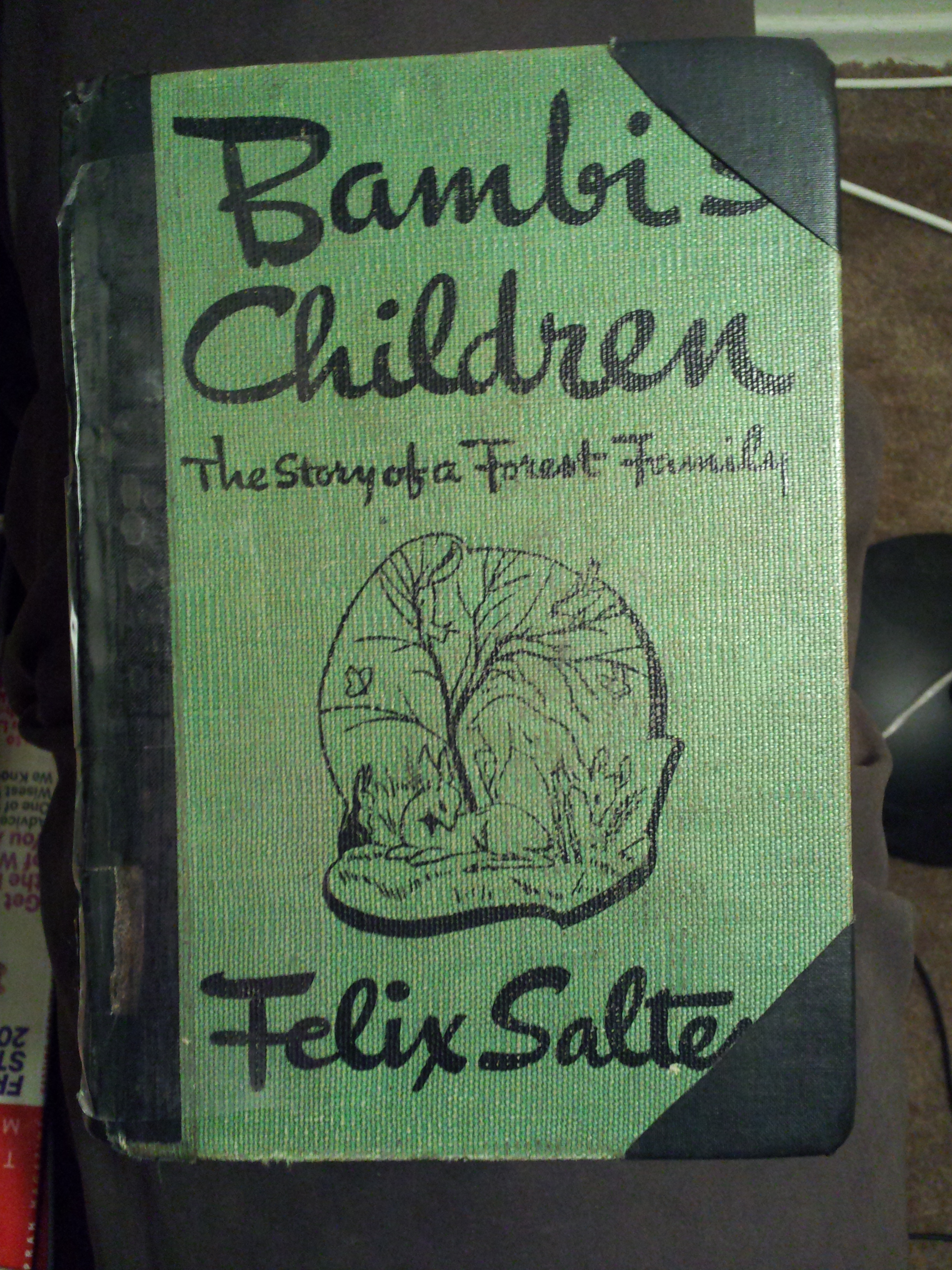
Bambi’s Children

Bambi’s children are named Geno and Gurri.  Geno is his son, Gurri his daughter.

I know this rather obscure fact because I spent the morning reading a beloved book from my childhood — Bambi’s Children, The Story of a Forest Family.  Yes, Felix Salten wrote a sequel to his famous book Bambi.  I had read it, over and over, when I was young, but then I moved, and I was never able to find another library with a copy that could be checked out and read.  Until last week, that is.  I was picking up two of Albert Payson Terhune’s Sunnybank books from the historical collection of my library system.  The librarian and I began discussing classic children’s books from the turn of the last century, and out of nowhere, she asked if I’d ever read Bambi (the real Bambi, not the shortened version that accompanied the Disney movie) and its sequel.  Wait, the library had a circulating copy of Bambi’s Children?  When she answered yes, I promptly requested it.


Bambi book

A much-loved, much-read book


I grew up in a small ‘patch town’ in northeasterm Pennsylvania.  My friends lived in other patch towns, and while we would meet often, we simply couldn’t spend every day together.  My parents, like my friends’ parents, both worked — even then, in those small towns, you needed two incomes in order to maintain a household.  Our parents simply couldn’t drive us, every day, to each others’ homes for what we’d call ‘playdates’ today.  Bus service between the towns was sporadic, and not always available at a convenient time for a child to go home.  And so, to pass the time, I dove into reading.

I devoured books.  Our library, while small, had a ever-expanding and varied children’s collection.   Although my mother worked evenings, every other Saturday we would run errands, and at some point, we’d end up at the library.  My mother, who loved to read as much as I did, would browse through the latest histories and historical novels (she was partial to the American Revolution, the Civil War and the kings and queens of Europe), and I would search through the shelves for new books on my favorites topics — mysteries, fantasies, historical stories and most importantly, animal tales.

Horses and dogs.  Dogs and horses.  While I diligently read my way through Nancy Drew and Cherry Ames, Tom Swift and tales from ancient Greece and Rome and Egypt, I kept coming back to the animal tales.  Sunnybank collies and Jim Kjelgaard’s Irish Setters.  The Black Stallion and his rival, the Island Stallion.  Kazan and Baree, wild dogs of the far North.  Marguerite Henry’s ponies and trotters and the King of the Wind.  I read them all, repeatedly.  Then one day, the libarian (and oh, I wish I could remember her name!) asked me if I’d read Bambi.  I explained that I’d seen the movie, and had the Disney books, and the coloring books.  Ah, she replied, but had I read the sequel?

There was a sequel?

And so I met Geno and Gurri, while renewing my acquaintance with Faline and Bambi, the great King of the Forest.  I followed the fawns as they grew up, facing threats from both nature and man.  I poured over the illustrations, because all of these books — Bambi and the Black Stallion and Big Red — contained lovely black and white (pen and ink?) drawings, or multi-color plates, that were interspersed throughout the book.


Bambi drawing

Bambi, Faline and Geno searching for Gurri


And I wondered whether our deer had conversations like the deer in Salten’s books.  My house was built on the edge of a forest.  In the autumn and winter, whitetail deer would wander into our backyard to eat the fallen apples from our trees.  I would sit in the window and watch the herd throughout the evening, giving names to the more distinctive animals.  I can still see Blaze in my mind — the deer had a streak of white running down its side.  Natural coloring, or a scar, I wonder today.

Second obscure fact — Bambi and his family are not whitetail deer, as portrayed in the Disney movie.  They are roe deer, native to Europe.  Similar to whitetails, but from what I understand, roe deer are smaller, alter color through the seasons and have virtually invisible tails.  However, they, like their American cousins, are rapidly increasing in numbers, especially in Britain.

I’ve read hundreds of books to my friend’s children over the years, and yet very few of these modern ‘classics’ compare to the simple beauty of books like Bambi and Bambi’s Children.  These books were not simplistic — Geno and Gurri lost friends to both man and beast, experienced hardships, learned difficult lessons about ‘adulthood’ — but somehow, they seem more entertaining than so many of the books available today.

Bambi’s Children was just as enchanting as I remembered it, and I’ve decided that, while I’m winnowing down my books in favor of digital editions, I have to find a good hardback copy to add to my collection.  Certain books are meant to be held and treasured.

Of course, I also want a digital copy, so I can read it whenever I want.  A digital copy that includes the wonderful drawings.  Digitize this book, please!  Bambi is already available, its sequel should be as well.

Coming home this evening, I passed two herds of deer, standing in the fields, watching alertly as my car drove by them.  The second group had 17 deer that I could see (I stopped and counted, while they studied me warily, prepared to run if I moved toward them).  The first herd had at least twice that number.

Geno and Gurri called their humans “Brown He” and other similar descriptive names.  I wonder what my deer would call me, if I could hear their thoughts?